

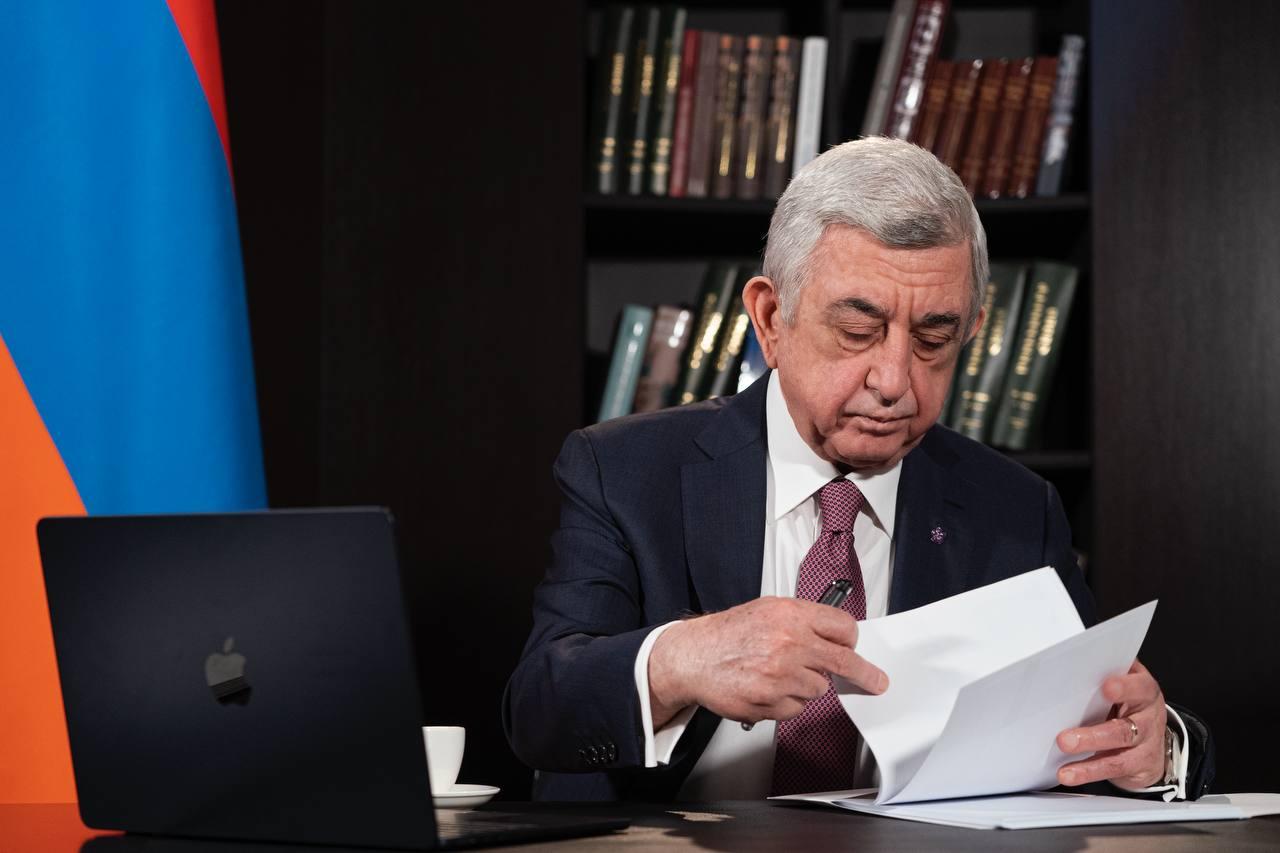
“The attempt by Pashinyan and his team to shift responsibility onto others has failed”.
— Serzh Sargsyan
10/12/2025
Serzh Sargsyan, the third President of the Republic of Armenia (2008-2018), responded to the Armenian government’s publication of a package of negotiation documents related to the Nagorno-Karabakh conflict.
The official commentary titled ‘What Does the Negotiation Package on Nagorno-Karabakh Reveal?’, which precedes the Armenian Government’s December 2, 2025 publication of documents related to the negotiation process on the Karabakh issue, is nothing more than a primitive — and ultimately futile — attempt to shift onto others the responsibility for the catastrophic consequences of the authorities’ failed Nagorno-Karabakh policies pursued after May 2018.
A very simple question arises: if, according to the assertions of Armenia’s current rulers, the negotiation process and the co-chairs’ proposals benefited only Baku, then why was it precisely the Azerbaijani side that, at least from 2008 until 2018, rejected all these proposals; criticized the co-chairs; and even called for their dissolution?
Azerbaijan, unlike Armenia, refused to adopt as a basis the five statements by the Presidents of the Co-Chair countries — Russia, the United States, and France — on Nagorno-Karabakh, made in L’Aquila, Muskoka, Los Cabos, and Enniskillen. Azerbaijan, unlike Armenia, refused to support the statements on Nagorno-Karabakh made from 2008 to 2017 by the OSCE foreign ministers on the margins of the OSCE Ministerial Councils, as well as the statement adopted at the 2010 OSCE Summit in Astana, or subsequently backtracked from its initial support. Azerbaijan, unlike Armenia, renounced the agreements reached at the summits in Saint Petersburg (17 June 2010), Astrakhan (27 October 2010), Sochi (3 March 2011), Kazan (24 June 2011), Sochi (23 January 2012), Vienna (16 May 2016), Saint Petersburg (20 June 2016), and Geneva (16 October 2017).
Having cornered itself in the negotiation process, Azerbaijan repeatedly threatened to withdraw from such negotiations until 2018, but never did so, fearing open confrontation with the three Co-Chair countries — the three permanent members of the UN Security Council in the meantime — which held the international mandate to mediate the conflict, and therefore fearing open confrontation with the entire international community as such. At the same time, through numerous ceasefire violations and by torpedoing the negotiation process, Baku regularly sought to provoke Yerevan into abandoning the talks in order to place blame on Armenia for derailing the peace process. But the Azerbaijani side was never able to achieve this.
Moreover, the positions of Armenia and the OSCE Minsk Group Co-Chairs had become almost fully aligned, as was publicly stated more than once. By rejecting virtually all proposals and initiatives of the co-chair countries, or regularly backtracking from agreements already reached, Azerbaijan effectively set itself in opposition not only to Armenia, but also to the international community in its approaches to conflict resolution.
After the change of government in Armenia in the spring of 2018, the need and importance of continuing efforts to preserve, consolidate, and further refine all that had been achieved over the years of the negotiation process — in order to reach a peaceful settlement — was evident. It was equally clear that deviating from this path could have unpredictable consequences. The OSCE Minsk Group Co-Chairs shared this view.
However, after May 2018, the new authorities in Armenia announced that they had decided to start negotiations ‘from their own point,’ effectively discarding the negotiation groundwork of previous years — yet they were unable even to explain to the co-chairs what exactly this ‘own point’ was. Whereas previously it had been repeatedly stated that Armenia’s position was aligned with the approaches of the OSCE Minsk Group Co-Chairs, at this time Yerevan came to be viewed by the international community as an unconstructive party in the negotiation process. And after the new leader of Armenia, ‘playing the fool,’ began voicing doubts that the conflict could be resolved through negotiations, Baku obtained what it had been unable to secure for many years as a casus belli – and accused Armenia of abandoning negotiations.
Could the war have been stopped? Possibly yes, if they had been prepared to deliver adequate counter-measures and if they had enjoyed the support and understanding of allies and the international community, who could have taken decisive measures to halt the hostilities immediately.
We witnessed such developments in April 2016. At that time, having failed on the diplomatic front, Azerbaijan launched aggressive actions against Nagorno-Karabakh, attempting to impose its approaches in the negotiation process by force — but these attempts collapsed spectacularly. Unlike that, Armenia in 2020 found itself in a deeply dire situation due to the obvious diplomatic, political, and military miscalculations of Pashinyan and his team, which led to a devastating military defeat with thousands of casualties and the loss of Artsakh.
Claims that during the negotiation process Russia, the other Co-Chair countries allegedly proposed returning to Azerbaijan the seven districts around Nagorno-Karabakh under Armenian control without offering anything in return — neither on status, nor on security guarantees, nor on any other parameter — are not only untrue but do not withstand any criticism. The Co-Chair countries of the Minsk Group have repeatedly stated this, and the documents published on December 2 by Armenia’s incumbent governors clearly confirm it.
Since December 2008 until the summit of the Presidents of Russia, Armenia, and Azerbaijan on 24 June 2011 in Kazan, the parties, with the mediation of Russia and the OSCE Minsk Group Co-Chairs, conducted negotiations on coordinating the positions of the parties to the ‘Basic Principles.’ Twelve bilateral (Armenia and Azerbaijan) and trilateral (Russia, Armenia, and Azerbaijan) presidential summits were held, along with three dozen meetings between foreign ministers. Each time, Azerbaijan backed away from the agreements previously reached. The culmination was the Kazan summit, when, contrary to the expectations of the Co-Chair countries, Azerbaijan effectively rejected the largely agreed-upon text by introducing more than ten amendments.
After Kazan, from 2011 to 2018, the Co-Chairs continued efforts to find ways toward a settlement. Following the ‘Basic Principles’ draft discussed at the Kazan summit (the last working document, which was deposited with the OSCE Secretariat alongside all working documents that had been the subject of negotiations up to 2011), there was not a single working document that became a subject of negotiation between the parties. It is no coincidence that Sergey Lavrov repeatedly stated that ‘no documents exist apart from those deposited with the OSCE.’
All materials produced from 2011 to 2018 were shared with the parties in ‘non-paper’ format and differed only in form — not in substance — from the document discussed in June 2011 in Kazan. The latest versions of these ‘non-papers’ were compiled into three interlinked documents forming a single whole. Taken together, they preserved virtually all the elements of the Kazan document and constituted a solid basis in which a comprehensive approach to resolving the Nagorno-Karabakh conflict was set forth.
The ‘non paper’ presented to the parties on 18 January 2018 in Kraków consisted of only three points, laid out on a single page, which, as proposed by the Co-Chairs, could have been incorporated into a possible future joint statement by Armenia and Azerbaijan. Baku rejected this proposal as well.
Only in June 2019, one year after Pashinyan came to power, was the first official (and not non paper) document since the Kazan summit delivered to the parties, signed by the Co-Chairs and containing proposals identical to those that had been presented without the Co-Chairs’ signatures in April 2019.
What provisions related to the Karabakh settlement were developed jointly with the Co-Chairs since 2008?
Interim status
Until its final status was determined, Nagorno-Karabakh was to receive an interim status with a detailed description of all its modalities, including: the formation and functioning of its own legislative, executive, and local government bodies; courts; self-defense forces and law-enforcement structures; obtaining observer status in the OSCE; and the right to membership in international organizations in which Nagorno-Karabakh’s interim status would not be considered an obstacle. It would be able to conduct external relations in areas specified by the agreement, receive direct foreign investments, assistance from international donor organizations and foreign states, and gain access to international markets. All of this, in practice, as the Co-Chairs themselves noted, amounted to ‘status quo plus,’ and in no way implied the cancellation of Nagorno-Karabakh’s existing status.
Final legal status
It was envisaged that the final legal status of Nagorno-Karabakh would be determined through a nationwide vote reflecting the free will of the population of Nagorno-Karabakh (the Co-Chairs insisted on this in all their proposals, despite Baku’s demand that a referendum on Nagorno-Karabakh’s status be conducted across the entire territory of Azerbaijan). This vote would carry legally binding force. It was emphasized that the formulation of the question or questions to be submitted for voting would not be restricted in any way, allowing for the choice of any status.
The population of Nagorno-Karabakh eligible to participate in the vote was defined as persons of all nationalities in the same proportions as existed in Nagorno-Karabakh in 1988, based on the results of the last census conducted before the outbreak of the conflict (according to that census, the Armenian population of Nagorno-Karabakh at the time constituted 76%).
Security guarantees
Under the conditions of the interim status, multi-layered security guarantees were envisaged: Azerbaijan’s commitment not to use force against Nagorno-Karabakh; an international peacekeeping operation with the deployment of peacekeeping forces; recognition of Armenia’s role as a security guarantor for Nagorno-Karabakh; security ensured by Nagorno-Karabakh’s own self-defense forces; security guarantees from the Co-Chair countries; as well as a corresponding UN Security Council resolution adopted for this purpose.
The corridor connecting Nagorno-Karabakh with Armenia
Until the determination of the final status, the security and all matters related to the use of the corridor through the Lachin region were to be ensured and governed by the authorities of Nagorno-Karabakh under the status quo conditions existing at the moment the peace agreement entered into force.
The final status and width of this corridor were to be determined in the context of defining the final status of Nagorno-Karabakh.
Return of territories
As part of a package agreement covering parameters such as the determination of final status, the corridor, and other elements, and only after clear international and other security guarantees — including guarantees from the UN Security Council — and after the peace agreement entered into force, the return of five districts was envisaged: Aghdam, Fizuli, Jabrayil, Zangelan, and Kubatli. These districts were to be demilitarized, and it was along the Line of Contact, not within Karabakh itself, that peacekeeping forces were to be deployed.
The return of the non-corridor part of Lachin and the Kelbajar districts was to be linked to the agreement on the organizational issues of conducting the nationwide vote to determine Nagorno-Karabakh’s final status.
Opening of communications
As part of the implementation of the settlement agreement, in the Kazan document — as well as in subsequent drafts — it was proposed to withdraw all reservations and special provisions from the relevant international agreements that restricted freedom of communications, to lift blockades, to ensure unhindered transportation and other links, and open all borders and communication routes passing through the territories of the parties (these restrictions had been imposed specifically by Azerbaijan). To reiterate more clearly: the proposals concerned the opening of communications throughout the entire region, without emphasis on any particular region or regions.
All proposals of the Co-Chairs envisioned a package solution to the Nagorno-Karabakh issue, with phased implementation in an interdependent sequence covering all components of the settlement.
It appears rather strange, not to say just outrageous, that in the small, selective compilation of documents on Nagorno-Karabakh published by the incumbent governors in Armenia, references are made to the statements of the 1994 OSCE Budapest Summit and those of the OSCE Chairperson-in-Office at the 1996 Lisbon Summit. Equally paradoxical is the publication of, and references to, the UN Security Council resolutions on the Nagorno Karabakh issue adopted in 1993. None of these documents — except by Azerbaijan — were recalled or cited by anyone, not by the UN, not by the OSCE, not by the Co-Chair countries, for at least ten years after 2008.
Pashinyan and his team have effectively turned themselves into apologists for the Azerbaijani leadership. Meanwhile, incumbent governors of Armenia are ignoring — just as Baku had done for many years — the statements on Nagorno-Karabakh adopted on the margins of the OSCE Ministerial Council meetings and at the OSCE Summit in the period of 2008–2017, not to mention the most important statements on the Karabakh settlement made by the presidents of the Co-Chair countries — Russia, the United States, and France — issued in 2009–2013 in L’Aquila, Muskoka, Deauville, Los Cabos, and Enniskillen. No less significant statements adopted on 16 May 2016 at the meeting of Presidents and Foreign Ministers in Vienna and on 20 June 2016 at the summit in Saint Petersburg are equally disregarded, as are the numerous joint statements of the presidents of Russia, Armenia, and Azerbaijan, now being consigned to oblivion.
By publishing several documents with reference to the website of the former Russian Co-Chair of the OSCE Minsk Group, V. N. Kazimirov, the Government of Armenia pretended not to notice the key trilateral, termless ceasefire agreements reached in 1994–1995 between Azerbaijan, Nagorno-Karabakh, and Armenia — agreements achieved in no small part thanks to Ambassador Kazimirov.
The list could continue. This, precisely, is the legacy that was handed over to the Government of Armenia with respect to the Karabakh settlement process — a legacy that Pashinyan’s administration handled with such incompetence and with such tragic consequences.
It would only be logical to suggest to the Armenian current rulers to publish the documents concerning Nagorno-Karabakh adopted after 2018. Let us hope that their scanning will not require too much time. Such a publication would clearly demonstrate what kind of legacy Pashinyan will leave to Armenia’s future leaders.
After all, upon coming to power, Pashinyan promised ‘to inform the people about everything,’ claiming that ‘the people had given him a mandate.’ Yet this promise ultimately was transformed into merely posting Facebook videos of bicycle rides in various corners of the world, taking selfies, eating pastries, and all sorts of trivialities. And finally, we heard the apotheosis of this approach: ‘I negotiate about whatever I want!’
And what is remembered regarding Pashinyan’s policy on Nagorno-Karabakh? Only two theses have remained in the public consciousness: first — ‘Artsakh is Armenia, period!’, and then — ‘Nagorno-Karabakh is Azerbaijan…’
The publication of the documents on Nagorno-Karabakh on December 2, as conceived by Pashinyan and his team, was intended not only to manipulate public opinion in order to discredit previous governments led by the three former presidents but also to shift onto them the responsibility for the failure of his own defeatist policy, framed as ‘peacemaking’. It was also aimed at distracting the public from the heavy burden of the tragic consequences produced by the incompetence of the current rulers. However, this attempt has completely failed and, in reality, has become an act of self-exposure for Pashinyan’s team — a verdict confirming its full responsibility for what has happened.